Wednesday, 29 February 2012

A Spectacular Chardonnay

Paul Hobbs Chardonnay, Russian River Valley, 2008
This is a wine that I have wanted to try for quite some time, since noticing it on the list at the restaurant where I work. Last night I got the chance, and it was worth every penny. I struggle to remember a white wine that has stunned me in such a way.
As someone who has ‘grown up’, as it were, on classic French Bordeaux and Burgundy, I have always been slightly sceptical of New World wines, and often discounted them (as I have mentioned in my previous post about Chile). However, this means that when I do come across something truly spectacular from the New World I feel I am more receptive of it: this is the case with the Paul Hobbs.
The 2008 Chardonnay saw a slightly troubled start to the growing season, which then exploded into a brilliant warm and stable summer, typical of the Russian River Valley in Sonoma County. The weather produced a well-defined and ripe crop which then responded very well to a year’s aging in 48% brand new French oak barrels. It was then bottled in January 2010 ready to be shipped out to be sold.
As soon as the bottle was opened the immediate area was filled with a luscious fruity sweetness and I knew it was going to be a bottle to remember. Once poured, it had a deep straw hue to it, with a sophisticated viscosity that suggested a high quality. On the nose, it presented with a hint of orange and pear, backed up generously by a thick oaky vanilla. On the palate the first impression it gave was a deeply developed honey with touches of butter. In terms of fruit, intense mango, pineapple and ripe apples are all evident, blended expertly with the richness from the oak and malolactic fermentation. The high alcohol content (14.5%) is not at all sharp and the wine does not appear ‘boozey’ in any way, which shows excellent craftsmanship. A lengthy finish with ever-developing textures of the oak makes for a truly enjoyable sip.
All in all, it is made with a strikingly Old World-style complexity: the balance and structure is never uneven, while all the flavours are impressively well-integrated. Available for around £30-40 it is not the cheapest wine around, but for a special occasion or the experience it is more than worth it. A true marvel from one of the most renowned New World regions.

Pictures from Paul Hobbs Winery website

Friday, 17 February 2012

Chile: One To Explore

For this post I am going to focus on some wines of Chile that I have recently tried and been very surprised with. Most of you I imagine, just as I did until last week, have a preconception that Chile produces cheap, not so high end, mass produced wine. To some extent this can be true. However, just the same can be said for California, South Africa, New Zealand, Australia and others, if one looks in the wrong place. I took some convincing it must be said, growing to enjoy wine by being taught on Burgundy, Bordeaux, the Mosel and Ridge Vineyards. 

Many winemakers in the New World are striving harder and harder to produce wine that emulates the Old World style of balance, depth, structure and perfect harmony of flavours and Casa Lapostolle are no different. My work recently at the Seafood Restaurant St Andrews has allowed me to taste a great variety of New World gems such as their 2010 Cabernet Sauvignon, which had me guessing blind that it was of high end Californian origin. The nose is met with an intense ripe blackcurrant, while the palate develops into an amalgam of cedar wood, loose tea and cherries. The smooth yet feisty tannins round off what has been one of the most shocking wines I've tasted recently. It is from the Colchagua Valley to the south of the Chilean capital of Santiago. The valley is known for its dry heat, yet in this particular wine although it is clearly from the new world, the heat is blended expertly to produce something in no way overpowering. It is attractively priced at between 8 and 12 pounds per bottle and would be excellent paired with any lamb dish.

Picture: Justerini and Brooks
Another Chilean wine that has caught my eye recently is the Palomar Estate Merlot, also from the Colchagua Valley. What impresses me about this wine is that although it is a single variety Merlot (which is quite uncommon due to the grape's richness) it is not overly thick and oppressive. It is from the eastern part of the valley which is slightly cooler, and this helps soften the grape. It still possesses all the characteristics that one would desire from a big New World single varietal. The nose presents with a chocolatey richness and deep ripe blackberries, while the palate gives a viscous woody sweetness with a lengthy gripping finish. At 6.50-9 pounds per bottle it is not one to pass up, and would be delicious with liver and onions, or a classic sunday roast: the bold flavours in both would complement each other and neither would be washed out. 

There are many more Chilean gems that I could describe to you, but the best way to understand is to try for yourselves! Do test out some if you get the chance, there is way more to Chile than the supermarket aisles suggest. 

Monday, 9 January 2012

The Old Parsonage Hotel, Oxford

Previously in this blog I have tried my hand at a restaurant review (Dinner At The Seafood Restaurant, St Andrews). However, I focused more on the wine pairings I had chosen, rather than the restaurant itself. So, here is my first foray into food criticism.
The Old Parsonage Hotel in Oxford is situated in a fantastic old building about 10 minutes walk from the centre of the city. It is framed in ivy and the front terrace garden makes it a particularly attractive and aesthetically enticing prospect. I have heard about the legendary Cream Teas which they prepare, as well as their outdoor live jazz evenings in the summer. In addition I have visited the other restaurants owned by the same man – the reasonable and fashionable Quod Brasserie and the slightly over-priced, yet inventive Gee's Restaurant – therefore it was high time I gave this one a go.
After being invited warmly to a table, the first thing that impresses me is the cosy feel of the room itself, dotted with framed paintings and characterful fittings. The tables were perhaps a little small, but as it is not a restaurant that serves 5 or more course tasting menus this is not a real problem. In terms of food, the menu seems fresh, mostly seasonal and wide-ranging. I had a razor clam starter served with a small, crisp salad with garlic and parsley breadcrumbs which was beautifully presented in the shells and very well-cooked. My main of roast partridge left a little to be desired in presentation, cooking and thought, which was a shame. The dish was extremely dry (not complemented by the supermarket-esque 'rosti') and it may have been a sous-chef who has not cooked whole game before, but the bird was rather raw on one side and over-cooked on the other. No matter, as the cabbage with jus was extremely good and masked the moisture-less bird. As for my companion there was nothing but praise for the blue cheese and nut salad as well as the risotto.
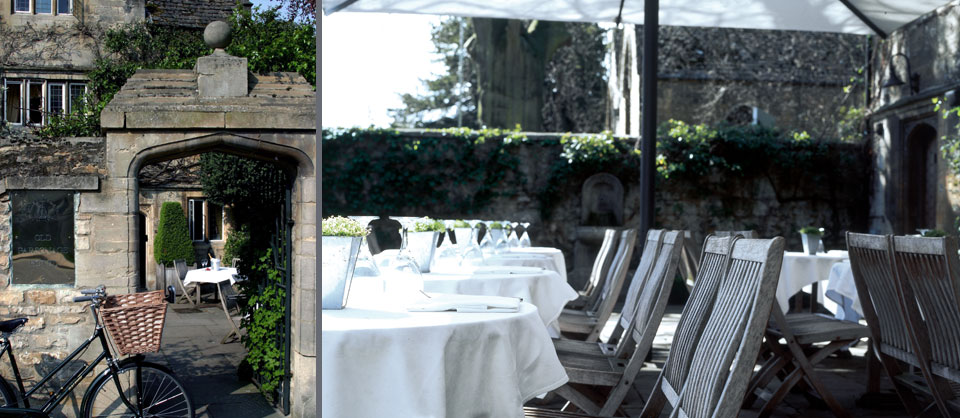
Pictures from Old Parsonage website, left.
The wine list is not one that expects to be winning any awards, but is absolutely what one would desire from this sort of restaurant. It shows thought with a wide range of countries and grapes from both famed and less well-known producers. A bold move in placing a couple of a merchant's 'own brand' wines on a dinner menu is completely justified as the sommelier has obviously chosen the right merchant in Berry Bros and Rudd. My only slight quibble would be slightly over-priced wine by the glass for what they are, but the usual tendency would be to opt for a bottle with dinner anyway.
Overall the establishment has impressed me – the staff were friendly and knowledgeable, and the menu looks mostly well thought out with a more than decent wine list to complement. I would heartily recommend it to anyone in Oxford with an evening to spare, despite the price nearly edging into the category in which one would look for hints of AA Rosettes. Dinner for two (2 courses) with wine and coffees costs roughly between 80 and 100 pounds.  

Tuesday, 20 December 2011

Traditional Christmas

After having seen for sale a bottle of non-vintage "Christmas Red Merlot" recently, I thought it would be a good idea to write about traditional pairings for a tradition-steeped day. If this type of Christmas is not your traditional one, I do apologise, but it has been mine for most of my life! I aim here not to direct anyone to particular bottles, but to general regions and grapes - as everyone's cooking will no doubt differ. 
As I'm sure many will agree, we can disregard breakfast as a chance to pair a wine for obvious reasons. The next meal at which I can see the cracking of a bottle would surely be during the Queen's Christmas Message in the early afternoon, when the main meal is starting to get under way. I have always had smoked salmon with lemon and some form of sparkling wine to toast at the end. I would always suggest the complexity and dryness of a Champagne, as it binds so deliciously with the oily, smokey fish and the sharp acidic lemon. There are some pitfalls with champagne - such as spending one's money on a bottle of Veuve Clicquot or Moet et Chandon, when near exactly the same money could buy Laurent Perrier, Pol Roger or even a Bollinger - so beware of mass-production! 
In my household we have never had Christmas dinner divided into courses as such, more a multitude of dishes laid all over the dining table with everyone being then invited to dig in. In that respect it is difficult to fit in a nice white without it being over-powered by the roast. Therefore I would always have a nice bottle of dry Riesling or Sauvignon Blanc as an aperitif on the go while waiting for the main event. As for regions, I personally would always go with an Alsatian Riesling or a Loire Valley Sauvignon Blanc. Call me traditionalist, but when there is no food to match I still feel they are the best crisp, fresh wines to drink. 
Christmas dinner food always changes, but it is most likely safe to say that usually a turkey, goose or duck appears somewhere, along with roast potatoes, bread and cranberry sauces, parsnips, carrots and brussels sprouts. With this array of robust and expressive flavours, the wine is crucial. In my opinion the perfect accompaniment would be a Burgundy (or a very good New Zealand) Pinot Noir. The flowery and aromatic style mixes very well with the light and dark meat of poultry and the jammy, ripe, fruitiness blends expertly with the sweetness of the sauces and vegetables. Typically well-suited regions I would recommend would be the Cote-de-Beaune in France, or Central Otago in New Zealand. 
As everyone I would hope is having a good time, my guess would be that the wine would not necessarily last too long. To mix things up a little, I would suggest to follow something heavier - to last into the serving of the Christmas pudding. For this, my recommendation would be for a good Bordeaux or a big, heavy Californian Grenache/Syrah blend. Both of these styles would work well towards the end of a Christmas dinner: the velvety, deep red berry texture of the Bordeaux would work with near any meal of substance, especially if any form of pork adorns the plate. A Californian Grenache/Syrah would lend a spicy, punchy note to the meal which would bind extremely well with the thick spiced Christmas pudding. Although both the wine and the pudding would be very high in alcohol, neither would be overpowering due to the mixing of spices and aggressive fruit flavours. 
By this time I am usually quite full and in need of a rest in front of the fire. There is, however, time for one last meal, and that means one last drink. In the evening with mince pies and Christmas cake the truly traditional accompaniment may be to some a sticky sweet Sauternes or Tokaji. My suggestions would be for either a Calvados (for those with a sweet tooth), or a nice Whisky. Something without too much saltiness and not too weak is the order - either a Highland or an Islay Single Malt would be perfect, giving a smokiness and a depth to the end of the evening. 
I hope this has put a few ideas in people's minds - and I wish everyone a Merry Christmas! 

Sunday, 4 December 2011

Christmas Presents

Having a bit of a delay between posts has worked out quite well, as now that it is truly advent I feel I can legitimately write about potential Christmas gift ideas. Bordeaux and Burgundy aside, I have chosen three wines which I think are interesting, a bit off the wall and above all, great value for money.

The first is sometimes a bit hit and miss when it comes to different vintages, but one that is, in my opinion, one of the best substitutes for a Burgundy that can be found. It is a South African Hamilton Russell Chardonnay. Try if you can to get 2007/8/9, as they are the best expressions of the wine. The vineyard is situated in the far south next to the sea in the Hemel-en-Aarde Valley appellation and enjoys a terroir and climate strikingly similar to that of Burgundy in France. The normal South African grapes are not found here, such as Chenin or Sauvignon and the Estate grows only Pinot Noir and Chardonnay. The soil is full of clay and shale and this lends an intense depth and minerality to the wine. I have tried the 2009 most recently and it is a deep gold colour, despite it's youth. The nose is much more elegant than one would expect from a South African wine and gives hints of lemon and lime, as well as white fruits and a hint of creamy honey that distinguishes it as a Chardonnay. The palate is extremely full-bodied and really shows its Old World style - there is no aggressive sweetness or any overdone flavours: just a fresh and lengthy finish of butter and low acidity. As a whole it is stunning value for money and would add to a great variety of foods. The price per bottle ranges from 22-28 pounds and should be available in most bottle shops. 
The second wine would be an appreciated gift for anyone who has a small cellar or any interest in wine - it is not what one would expect at all. It is Charles Smith's 'Velvet Devil' Merlot from Washington State. Mainly interesting for the simple reason that good Washington wine is extremely underrated. I have tried the 2008 and it literally does what it says on the tin: the tannins are extremely soft and barely noticeable, the flavours are plush, soft and inviting and there is just the slightest hint of spice at the finish. Not one to save for a special occasion, but certainly worth a try - it is an off the wall gift wine. It is available for around 18-20 pounds per bottle from bottle shops. 
The last wine I would suggest as a gift is a Californian Pinot Noir, and one that is simply excellent value for money. Au Bon Climat's Santa Maria is a delicate, elegant and developed wine that would be appreciated by anyone. It is distinctly Californian - the heat shows through in the ripeness and full flavours throughout from the nose to the finish. There are notes of rich leather and a dusty farmyard blended expertly with ripe red fruits and a hint of jammy sweetness on the lengthy well-balanced finish. Interestingly the wine develops with some time open, unusual for a Pinot Noir, but for this one it works. The flowery fruity nose becomes more pronounced and a new complexity is gained on the palate. The wine maker Jim Clendenen describes it as lush, fragrant and bursting with berries, which is exactly what it is. It is attractively priced at between 15-20 pounds per bottle. 
I hope this gives you some ideas for gifts if wine was an option - happy buying!


Friday, 18 November 2011

Islay: Whisky Wilderness

For my next post I am going to write up a trip I took last week with a couple of friends to Islay, an island off the West Coast of Scotland. Islay is right next to Jura, which is known for its hunting, and the main attraction on this more fertile island is its whiskies. There are eight distilleries on Islay and the distinguishing characteristic that most people will recognise even if they haven't visited is the peated nature of the spirit. This trip was to appreciate smoked malting and peated whisky - something not found normally with other whiskies I've been used to on the East Coast, such as those from Speyside.

On our first day we woke up early and drove to the ferry at Kennacraig in Argyll. The journey across to Port Askaig took about 2 hours and was stunning - we had perfect weather for the crossing and anyone can appreciate the natural beauty of sailing up the tidal channel between Islay and Jura. Immediately after our arrival we drove down a tiny single track road to our first port of call, Caol Ila Distillery, which turned out to be closed for renovation. A mile or two north however, Bunnahabhain was open. The first thing we noticed when we arrived was that the whole area smelled deeply of malting - a welcome smell at 11 in the morning! After a brief tasting we moved on to Bruichladdich on the other side of the north part of the island, a mere 8 or so miles. With a view across the sun-soaked Loch Indaal towards Bowmore we settled down to a tasting from an incredibly friendly staff. Bruichladdich is, unlike many distilleries, privately owned and run still. Although this naturally doesn't make its whisky better or worse, it appealed to me in some sort of sentimental way. The enormous selection of whisky, and even gin and rum, was impressive and certainly eye-opening for someone who knows very little about detailed whisky tasting. Stand-out drams turned out to be their 16 year old Bordeaux cask selection and their 'Octomore'. For the 16s they have casked them in 5 different types of wood, from Pauillac, Margaux, Sauternes, Pomerol and Medoc - the difference in sweetness and depth of flavour purely from the wood ageing was amazing and certainly reflected the characteristics of the wine the regions produce. Definitely one to try for you wine enthusiasts out there! The Octomore we learned is the world's most heavily peated whisky. I was certainly a bit apprehensive about trying this because my only previous experience of peat has been Laphroaig which has never sat that well. Laphroaig and other peated whiskies have a classification of about 30-40parts per million, while this Octomore the lady proudly let us know was 167. With a alcohol percentage of about 60% Cask Strength it was a formidable whisky and worth trying for the experience - it is incredibly intense and quite incredible how they manage to produce something so balanced and so strong.

Following Bruichladdich we saw a bit of the incredible island itself, visiting the remote Machrie Bay on the Western shoreline, with the newest distillery on the island nestled on a farm nearby, Kilchoman. The setting was incredibly serene. Probably due to the time of year it was deserted, but we got the sense that even in the height of summer it would still retain its rugged, remote wilderness. To finish off the day we enjoyed a dram of Bowmore 15 Year Old in the Bowmore Distillery tasting room overlooking the Loch from the other side as Bruichladdich.
Our second and final day on Islay was more blustery and overcast - what we had been expecting from a Scottish Island! We started by driving out to the Mull of Oa, the south western tip of the island which is the most remote part with little more than a scattering of farm houses over ten square miles. On the edge of the cliff there is an American monument to a sunken troop ship lost in 1918 and in the wind it provided a surreal backdrop which seemed to typify the island: its rugged nature and sheer remoteness.

After our dose of culture and exercise we walked from our hotel in Port Ellen eastwards with a view to tasting as the 'big three' of Laphroaig, Lagavulin and Ardbeg. Lagavulin turned out to be closed, but we managed to get our fill of smokey peated whisky at the other two. Laphroaig provided us with a great museum of the distillery and generous tasting drams, but with less of the passion that was evident at Bruichladdich. We had heard that Ardbeg was the best for visitors, however, and we were not disappointed when we trekked the 3 miles out to it. After lunch in the cafe we took a tour of the distillery itself which was extremely informative and detailed the 5 main whiskies they sell today. The most interesting of these is the Alligator which uses charred casks to provide depth of flavour and smokiness to it. The inside of the barrels are burned to about an inch deep to the point where they crack like an alligator skin. The difference is marked from the rest of their whiskies which are all based on the same 10 Year Old - there is a much more complex and developed flavour which isn't harsh or aggressive like other peated whisky I have tried, such as the Laphroaig.


Overall the trip taught me about both whisky and the Western Isles: I learned about the distillation process and about how much peat can affect taste, depending on how smoked it is, and about the differences in each distillery's styles. But more amazing was the island itself: it was simply stunning. The southern coast was rocky and rugged, with enormous cliffs on one end, bays on the other. The north was lush and covered in hidden beaches and beautiful sheer drops to the sea. In terms of it being a visitor 'attraction', I would recommend it as a destination to anyone. The people were extremely friendly, especially at the distilleries. They seem to love being there and working with something so historically rooted there. It was also cheap and easy to get to - the only problem was the issue of the designated driver when heading to the distilleries!

Stand-out Islay whiskies from the trip that are worth ordering when you are next stuck in a bar for what to order would be Ardbeg's Alligator, Bruichladdich's 16YO Bordeaux Casks, The Octomore or Bruichladdich's 'Peat'. Happy drinking and do visit for yourselves.

Monday, 7 November 2011

'Grand Vin de Bordeaux': Worth the prestige and expense?

I've had a lot of people come up to me over the past few weeks at wine events saying that they can only tell if what they are drinking is wine or not when given a taste. To someone who loves wine and knows about production, geography and varietals this seems a bit ridiculous, but it is something I understand. Until a couple of years ago I too could certainly not tell whether a wine was Pinot Noir or Cabernet Sauvignon, Chardonnay or Sauvignon Blanc, or whether it was corked. Because of this paying more than the standard bottle shop/supermarket price for wine seems like an alien concept to many. Should it be? Recently I have had the pleasure of being able to try a 1990 Chateau Margaux and a 1995 Chateau Lafite-Rothschild (both between 600 and 800 pounds) and it made me think about what is worth paying for.
Obviously as a student I do not have the money to be splashing on 800 pound bottles of wine, but hypothetically would it be worth it?
The Margaux was brought in to the restaurant I work at by a group of American businessmen. The bottle was an Imperial (6 litres) and features in the display picture for this blog. It was decanted into 8 decanters on the table with about a decanter's worth of thick sediment left in the bottle. It made quite an impression and was simply a stunning addition to the evening. The group left the waiters about a full decanter for us to enjoy after the shift which worked out at about 1100-1200 pounds of wine - not a bad tip at all! It turned out to be one of the most mind-blowing wines that I have ever tried. As soon as the bottle was opened intense and deep aromatics were noticeable all around. When tried after opening, the palate is tight and concentrated following a perfect blend of smells from all over the world - notes of delicate spices mix seamlessly with truffles, ripe fruits and dark licorice. The taste is intense and lengthy, lasting for two full minutes and recurring for the next ten. Once left for a couple of hours the development is marked. The nose becomes dominated by deep dark fruits, particularly cherry. The spices and other flavours hover in the background adding complexity and depth. On the palate the wine is full and creamy, with a viscous thickness to add to the sweet tannic grip. The length of the taste is just as long 3 or 4 hours after opening as it was immediately afterwards.
This Chateau is regarded as one of the premiers chateaux in all of Bordeaux and I can see why - this year is just reaching its mature drinking age at 21/22 years old and the composure it holds suggests many more years of drinking ahead. This vintage has consistently scored between 95 and 100 points and that is certainly what I would rate it.
The Lafite-Rothschild I tasted 10 hours after it had been opened and although there was a hint of it turning from over-exposure to air, there certainly was a lot left in the tank. As one would expect from a wine so geared towards ageing this vintage was young: noticeably so. There was a tightness that left a few flavours hidden within the wine, that will open with age. Having said that, the complexity and balance is remarkable. It was not as smooth and sweet as the Margaux, and had a great deal of smokey, tobacco meatiness to it. This matched well with its truffled earthiness and dark fruit spice. The length of the wine on the palate was again extraordinary, lasting a good minute despite the length of time after it had been opened. The Chateau is situated in Pauillac in Bordeaux and is generally regarded as one of the top 5, along with Chateau Mouton-Rothschild, Chateau Margaux, Chateau Latour and Chateau Lynches-Bages. It is near impossible to fault in any way and also scores into the high 90s at tastings.
For both of these wines once they are tasted it is very difficult to find a reason why one would not buy them in a hypothetical situation. Because of the complexity of the flavours, the depth and length of the taste on the palate and history behind them there really is no way anyone could turn them down in favour any others. It seems then that 'Grand Vin' is worth the price - it still has its place.